
Relational Intelligence: The Key Competency for Those Who Lead People and Organizations
In my work with entrepreneurs, managers and business teams, I often meet brilliant, technically impeccable people who struggle to achieve lasting results with their collaborators. Not because they are not capable. But simply because no one has ever taught them how to manage relationships consciously.
“Nobody taught me this” either (even though I think I’ve had many “unwitting teachers”) but since people often point out to me that I’m “good at relationships” I started to think about it a bit and from these reflections something bigger developed… but, let’s go step by step, one thing at a time.
In a world of work where we constantly talk about AI (it seems that DeepSeek will soon also serve sandwiches at Sarniglill) hard skills, automation, performance and productivity, we forget that It's people who make the difference. And when you work with people — whether in a microbusiness or a multinational — the relationship matters more than the process.
That’s why I decided, together with my colleagues at OSM, to dedicate time, energy and resources to developing a practical and measurable model of relational intelligence.
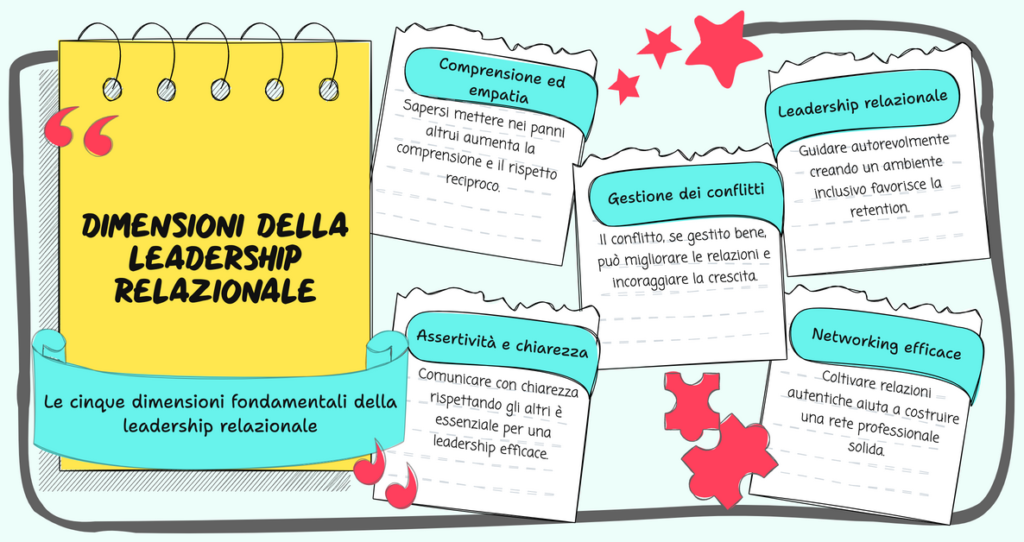
🔍 The 5 dimensions (according to our experience) of relational intelligence
We didn't write this part by reading American books with motivational titles. We built it by observing real managers, real teams, real business situations. It is the result of years in the classroom, individual coaching, feedback received and even a few nice corporate culture crashes.
Through all this field work, we have identified 5 fundamental dimensions that make up relational intelligence. Each of these is not a “nice idea” or a theoretical principle, but an area that can really be worked on, in a practical, targeted way, with concrete results.
1. Understanding (empathy and active listening)
The ability to put yourself in someone else's shoes, listen without judging, pick up on verbal and non-verbal signals. A leader who doesn't listen doesn't lead, he commands. And that's not the same thing.
2. Assertiveness and communication
Know how to communicate clearly, respectfully and consistently. Say “no” without destroying, say “yes” without pleasing. Face difficult conversations without creating tension.
3. Conflict Management
Conflict is inevitable. But it can be a lever for growth, if you know how to deal with it. A good leader does not avoid comparison, turns it into an opportunity.
4. Relational Leadership
Lead with authority and respect. Value diversity. Create a climate where people feel seen, heard, involved. This is where the real game of retention is played.
5. Networking and relationship building
Cultivate solid and authentic professional relationships. Not just “having contacts”, but knowing how to create meaningful connections. Because those who know how to network, know how to do business.
📈 Can it be measured? Yes. And it can be improved, even better, right!?
The 5 Dimensions of Relational Intelligence are not just beautiful to read: they are measurable. And above all they are trainable. For this reason, within the OSM training path, we have built a real relational intelligence test.
Those who participate in the course receive a custom report which includes:
- Your score on each of the 5 dimensions
- A relational profile based on the professional role
- A comparison with the average of other similar professionals (benchmark)
- Practical tips on how to improve each area
Because you don't grow up with good intentions. You grow up with awareness and constant training.
📚 Want to learn more?
I told the behind the scenes of this journey, how the test was born and why we believe so much in relational intelligence. If you are interested in going beyond the theory, and discovering how it can change the way you lead people and teams, read here:
 English
  Italian