
📌 Constructive criticism doesn't exist: how to build without criticizing
There constructive criticism it's an excuse, a figure of speech, a trick to criticize while deluding oneself into thinking one won't pay the consequences in terms of motivation and involvement.
Am I saying that no one should ever be corrected, trained, or helped to improve? No, absolutely not. However, these are extraordinary moments in the growth path of an employee.
📌 What I can say with certainty, however, is that the rhyme of “constructive criticism” must not become the norm.
And, above all, that it is possible to build without criticizing.
Anyone who has managed a team has heard (or said) at least once a sentence that begins like this:
👉 “Don’t take offense, but… can I offer you some constructive criticism?”
And the reaction of those who receive it? 90% is sometimes a mix of defense, discomfort and demotivation.
💡 Why? Because the human brain doesn't distinguish between "constructive" and "destructive" criticism.
He just senses that he is under attack.
📌 In years of experience as a CEO of Open Source Management (OSM), I've seen how eliminating criticism transforms team engagement and increases productivity.
Let's see why and How to transform criticism into a truly effective tool for improving performance without undermining motivation.
🔍 Why is constructive criticism NOT constructive?
📌 Three negative effects of criticism, even when it is “constructive”:
- ❌ Activate the defense. Nobody likes to be told they made a mistake.
- ❌ It stifles initiative. If every attempt is followed by a correction, people stop daring.
- ❌ It focuses on the past. Analyze the mistake, instead of pushing for future growth.
📌 Here's the truth: Constructive criticism isn't what's needed. A completely different approach is needed.
🚀 Roadmap to move from "constructive criticism" to real construction
1️⃣ Moving from judgment to curiosity
📌 Common mistake:
👉 “You messed up this report, you need to be more specific.”
📌 Effective alternative:
✅ “What did you find most difficult about this report? What information would you have needed to do it better?”
2️⃣ Replace “Yes, but…” with “Yes, and…”
📌 Common mistake:
👉 “Great idea, but I don't think it would work because…”
📌 Effective alternative:
✅ “Great idea! What if we adapted it this way to make it even more effective?”
3️⃣ Recognize progress first, then areas for improvement
📌 Common mistake:
👉 “You did a good job, but there are some things that aren’t right.”
📌 Effective alternative:
✅ “I've noticed a big improvement on this one. What do you think we could work on together on this other aspect?”
4️⃣ Create an environment where it is safe to make mistakes
📌 Common mistake:
👉 “We can't afford any mistakes!”
📌 Effective alternative:
✅ "What have we learned from this situation? What solutions can we find?"
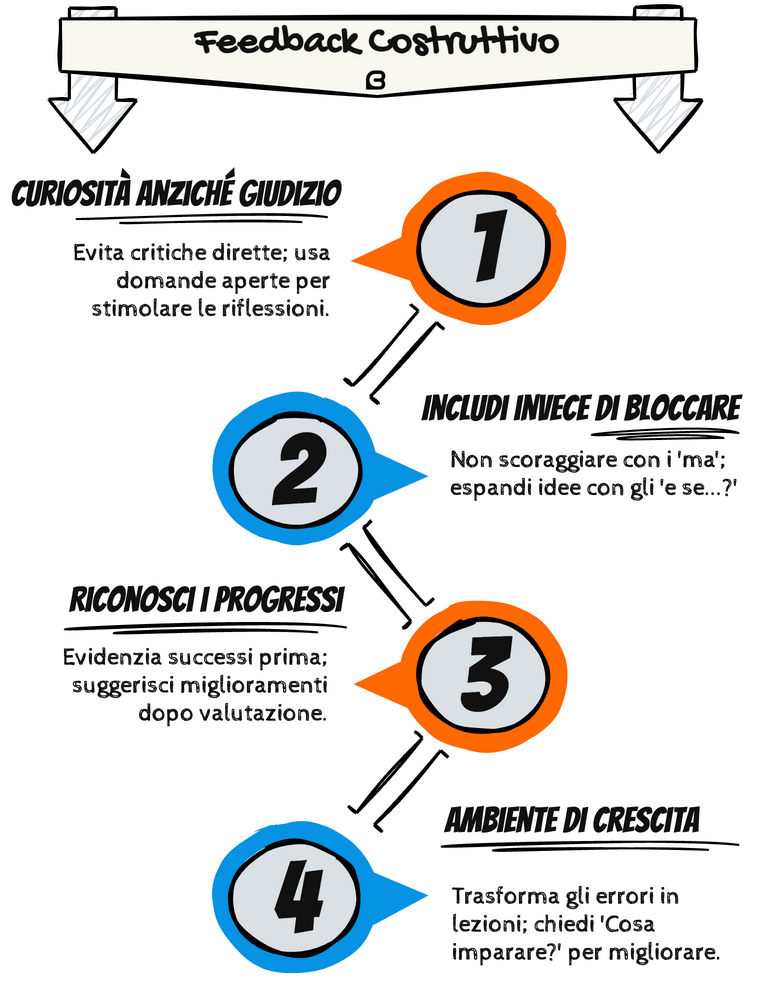
The Constructive Feedback Roadmap
🚀 Building without criticizing is possible
📌 To recap:
- ✅ Criticism, even in a “constructive” way, blocks growth.
- ✅ Replacing judgment with questions opens the way to improvement.
- ✅ The “Yes, and…” enhances ideas instead of demolishing them.
- ✅ Recognizing progress helps strengthen motivation.
- ✅ Creating a safe environment makes people more positive and productive.
🔗 Academic resources for further study
🔍 Learn more
✔️ Negative Emotional Reactions to Criticism
A study by Neoh et al. (2022) exploring the emotional distress caused by poorly handled criticism, particularly from supervisors.
✔️ Productive Criticism: A New Environment for Feedback
An analysis by Weisinger (1996) of the impact of negative criticism on collaboration and communication in work teams.
✔️ Negative Effects of Destructive Criticism: Impact on Performance
A study by Baron (1988) analyzing how destructive criticism reduces workers' motivation and self-efficacy.
✔️ When is Criticism Not Constructive? The Roles of Fairness
A research by Leung et al. (2001) highlights how the perception of unfair criticism can lead to resistance and conflict.
✔️ Effects of Perceived Criticism on Anxiety and Depression
A study by Steketee et al. (2007) showing the correlation between negative criticism, job anxiety and depressive symptoms.
✔️ The Rules of Engagement: Social Conventions Surrounding Criticism
An analysis by Jeffries (2011) of the effects of poorly handled criticism on stress levels and mental well-being.
📌 If you'd like to learn how to apply these principles in your business, let me know in the comments or contact us at OSM! 🚀
 English
  Italian